
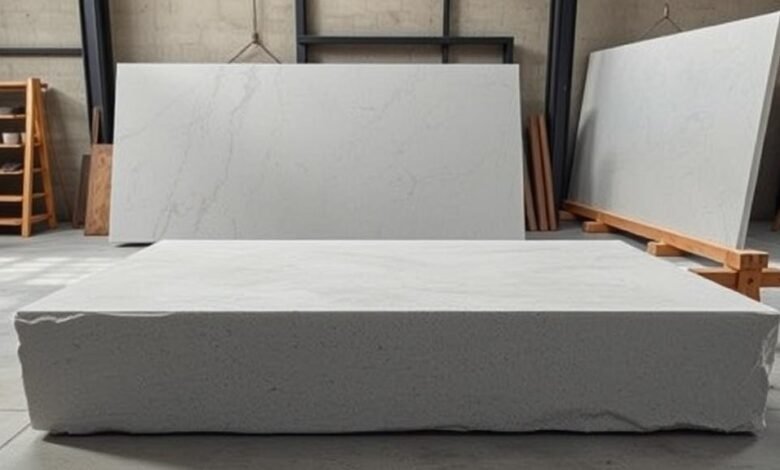
Slab Yield Math: Where Your Shop Loses Money matters only if it makes quoting, layout, or production cleaner for the people doing the work. The real standard is fewer surprises between the estimate and the install.
Cover image suggestion: A shop owner standing in the slab yard with a measuring tape on a partially used slab, the remnant piece visible behind him.
Meta description: The math behind slab yield in countertop fabrication, where small percentage losses add up to large dollar losses, and the operational practices that move the number in the right direction.
Last spring, Marco Delgado walked me through the off-cut area behind his fabrication shop in Marietta, Georgia. Forty-seven remnants on A-frames, some of them tagged with dates going back to 2022. He did the rough math on his phone: about $31,000 in material, retail cost, just sitting there. “I told myself every one of those was an asset,” he said. “But nobody’s buying Taj Mahal in a 14-by-22 piece.” He laughed, but it wasn’t really funny. That pile was a symptom of a bigger problem, one most shops share but few measure honestly.
The number that matters most on a stone fabrication shop’s P&L is slab yield. Most owners I talk to either don’t track it or track it badly. The ones who track it accurately and actually work on improving it are the ones running the best margins in the trade.
See also: Tech Etruesports: The Technology Powering Etruesports
The Yield Calculation (and Why Most Shops Get It Wrong)
Slab yield is simply the percentage of purchased slab material that ends up installed in customer kitchens, rather than scrapped, broken, or gathering dust on a remnant rack.
Total square footage installed, divided by total square footage purchased, over a given period. That’s it.
A well-run shop lands between 84 and 90 percent. Below 75 percent, you’re leaving real money on the shop floor. Above 90 percent, you’re either exceptional or you’re measuring incorrectly. The honest middle is most of the trade.
Here’s the thing: the most common measurement error is counting off-cuts as “installed” because they might be used on a future small job. They might. They usually don’t. That remnant sitting on the rack for nine months is tying up working capital and taking up space, and it is not yield in any meaningful sense.
The second error is measuring purchased slab in slab count rather than square footage. Slabs vary in size. Counting them as units obscures the real material flow, like tracking grocery spending by number of bags instead of dollars.
The third error is picking the wrong time window. A month is too short. The slab that came in this week may not install for three or four weeks. A quarter gets closer. A trailing 12-month average is the most honest number for a stable operation.
A shop running this stone-shop software with slab inventory tracking built in can pull the actual yield number out of the system with the right report setup. The number is usually different from what the owner thought it was, and the gap is informative. Sometimes uncomfortably so.
Where the Missing Percentage Actually Goes
When yield is below 85 percent, the lost material lives in three places.
Nesting decisions. The salesperson or layout person made a choice that left more waste on the slab than necessary. A different cut path or a different slab assignment would have left less. This is where most shops have the most room to improve, and it’s also the place where time pressure does the most damage. A rep juggling four quotes before lunch isn’t optimizing cut layouts. They’re getting through the day.
Breakage. A slab cracked during cutting. A piece broke during handling. A polish step damaged an edge. Well-run shops keep breakage below 2 to 3 percent. Less disciplined shops lose 6 to 8 percent or more. The difference is training, equipment maintenance, and honestly inspecting slabs for hidden fissures before they hit the saw.
Off-cut accumulation. The pieces too small for the current job but too big to throw away. They migrate to the back lot and slowly multiply. They have real value in theory and limited value in practice. Marco’s $31,000 wall of remnants is a textbook example.
Nesting Is Where the Money Is
This is the single biggest yield lever, and it’s mostly an information problem.
A slab is, say, 120 inches by 65 inches. The pieces needed for a kitchen include a perimeter run of 25 square feet, an island top, and a backsplash run. How those pieces get positioned on the slab determines how much material gets used and how much gets left behind.
A manual nesting decision made by a salesperson with limited time and pressure to move on to the next quote is often suboptimal. Not because they’re bad at their job, but because the combinatorial math of fitting irregular shapes onto a rectangle, while respecting grain direction and seam placement, is genuinely hard for a human brain under deadline.
Software-assisted nesting that considers slab dimensions, piece geometry, grain direction, and seam placement gets closer to optimal consistently. The yield improvement from making that switch, based on shops I’ve talked to, has been in the 4 to 8 percentage point range depending on the starting point.
On a $2 million revenue shop, that range represents real money. I’ll do the math below.
Breakage and the Shop Floor
Breakage is partly about handling, partly about slab selection, and partly about the physical environment.
A slab with a hidden fissure the inspection missed is more likely to break during cutting. A slab handled by an inexperienced crew is more likely to crack on the lift. Uneven shop floors cause chips in transit to the saw. None of this is mysterious. It’s boring, incremental operational stuff: train people, fix the floor, inspect slabs properly before committing them to a job.
The breakage rate responds well to staff training and layout improvements. A shop that’s done both runs lower breakage than one that hasn’t. Pretty obvious, but it’s remarkable how many shops treat breakage as an act of God rather than a process problem.
Actually Using the Off-Cut Pile
The shops that realize value from off-cuts have a process for tracking them in inventory, matching them against incoming small jobs (vanities, repair work, custom pieces), and turning them over. The shops without a process let the pile grow until it becomes a disposal headache.
A reasonable target is turning over the off-cut inventory at least twice a year. Remnants sitting longer than six months are almost certainly never going to be used, and the working capital tied up in them is real. At some point you have to cut your losses, price the remnants aggressively, and clear the rack.
The Composite Picture
A shop running at 78 percent yield can usually move to 85 percent over 12 to 18 months with focused work on nesting, breakage reduction, and off-cut management. That seven-point improvement on a $2 million shop works out to roughly $140,000 of material that no longer gets thrown away every year.
None of the work is exotic. The math is straightforward. The execution, as always, is the hard part. But $140,000 is $140,000, and for most shops that’s the difference between a good year and a mediocre one.
Frequently Asked Questions
What is a good slab yield percentage for a countertop fabrication shop? A well-run shop typically lands between 84 and 90 percent. Below 75 percent signals significant material waste. Above 90 percent is possible but uncommon, and worth double-checking your measurement method before celebrating.
How do I accurately measure slab yield? Divide total square footage installed by total square footage purchased over the same period. Use square footage, not slab count. Use a trailing 12-month window for the most reliable number.
What is the biggest factor reducing slab yield? Nesting decisions, meaning how pieces are laid out on the slab before cutting. This is where shops typically find the most improvement, often in the 4 to 8 percentage point range when moving from manual layout to software-assisted nesting.
How much does poor slab yield actually cost a shop? On a $2 million annual revenue shop, moving from 78 to 85 percent yield recovers approximately $140,000 in material cost per year. Even a 2 to 3 point improvement makes a meaningful difference on the bottom line.
What should I do with accumulated off-cuts and remnants? Track them in inventory, actively match them to incoming small jobs, and set a target of turning them over at least twice a year. Remnants older than six months should be priced to move or disposed of. Holding them indefinitely ties up capital with diminishing likelihood of use.
How can I reduce slab breakage in my shop? Focus on three areas: thorough slab inspection before cutting (especially for hidden fissures), staff training on proper handling technique, and physical improvements to the shop floor and material transport paths. Well-run shops keep breakage at or below 2 to 3 percent.
Does software-assisted nesting really improve yield that much? In the shops I’ve spoken with, yes. The improvement typically falls in the 4 to 8 percentage point range. The software handles the combinatorial complexity of fitting irregular pieces onto a slab while accounting for grain direction and seam placement, something that’s genuinely difficult to do optimally by hand under time pressure.
Stone fabrication generates respirable crystalline silica dust. Shops must follow OSHA 29 CFR 1926.1153 standards (50 μg/m³ PEL over 8-hour shift). Wet-cutting methods, ventilation, and respiratory protection are not optional.

